
Across England, food partnerships are facing a familiar but deepening crisis. Insecure funding, shrinking resource, and the ever-present risk that embedded, resilient local approaches to food security and sustainability suddenly disappear with contracting charitable funding and Local Authority budgets.
Precarity won't be new to those working in the third and fourth sector. But as local food systems coordination becomes increasingly embedded in health, anti-poverty, land-use, resilience, food production and climate strategies, the case for statutory funding for this critical infrastructure begins to make itself.
As Sustainable Food Places (SFP) 2025 Impact Report evidences – Food Partnerships are more than strategic coordinators – they activate and accelerate the local food activity that transforms food production, food consumption and food identities:
“Partnerships described a wide variety of tangible achievements — including co-developing local food strategies, influencing public procurement practices, securing ‘Right to Grow’ council motions, establishing food hubs and growing spaces, and improving access to food through community fridges, pantries, and dignified food support initiatives.”
The four nations of the United Kingdom have a genuine opportunity to learn how to embed and sustain the kinds of place-based infrastructure that builds resilience and access to healthy and sustainable food. Right now, the clearest lesson is coming from Wales - one that SFP believes Scotland, Northern Ireland and England would do well to absorb.
So, what could the impact of statutory funding be on the depth and reach of food partnership activity, on the strength of local food networks, on communities' capacity to tackle the root causes of food poverty? This doesn't need to be a thought experiment: Wales offers a live test case.
What investment looks like
In June 2022, the Welsh Government committed to funding cross-sector food partnerships in every LA area as part of a series of intervention packages to help alleviate poverty, announced during a Cost of Living Summit. Over subsequent years that commitment has deepened. The Welsh Government has continued to support and strengthen Local Food Partnerships -building resilience in local food networks through the coordination of grassroots-linked, food-system strategy.
What is particularly significant about the Welsh approach is where the funding sits: currently, Local Food Partnerships are supported through both the Social Justice and Equality and the Rural Resilience and Sustainability divisions of Welsh Government -a formal recognition that food systems work is not a single-issue concern. It crosses health, poverty, land use, climate and community resilience simultaneously, and the funding architecture now reflects that.
Local Food Partnerships have been an important delivery mechanism for Community Food Strategy and have great potential to support the development of the National Food Strategy committed to by the new Welsh Government. This is what it looks like when government treats food partnerships as infrastructure rather than projects: not a one-off investment, but a sustained commitment woven into strategic planning across multiple policy areas.
What the data shows
The impact of that commitment is evident in the data. Sustainable Food Places tracks membership and award progression across the UK –and the contrast between Wales and England is notable [1].
Wales now has food partnerships that are SFP members covering 59% of its local authority areas. England, without equivalent national investment, sits at 27%. Scotland and Northern Ireland reach 50% and 45% respectively.
In Wales, there are 22 Local Food Partnerships, one in each local authority area, promoting innovation and best practice in healthy and sustainable food systems. Fifteen of these food partnerships are also Sustainable Food Places members.
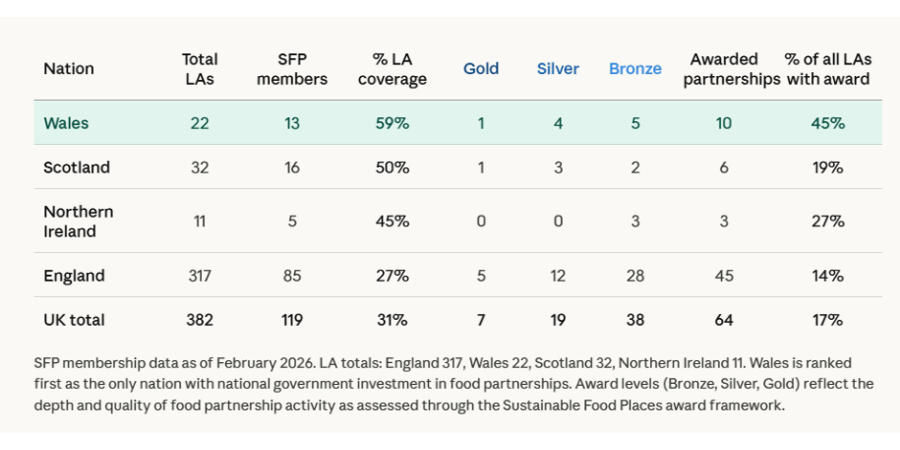
But membership figures alone tell only part of the story. The SFP award framework - spanning Bronze, Silver and Gold - measures the depth and quality of food partnership activity: the breadth of themes being addressed, the impact of local delivery in changing food access and environments, the strength and representation of cross-sector collaboration, the embeddedness of the partnership in local systems. It is a proxy, in other words, for how far beyond pure coordination a partnership has been able to go.
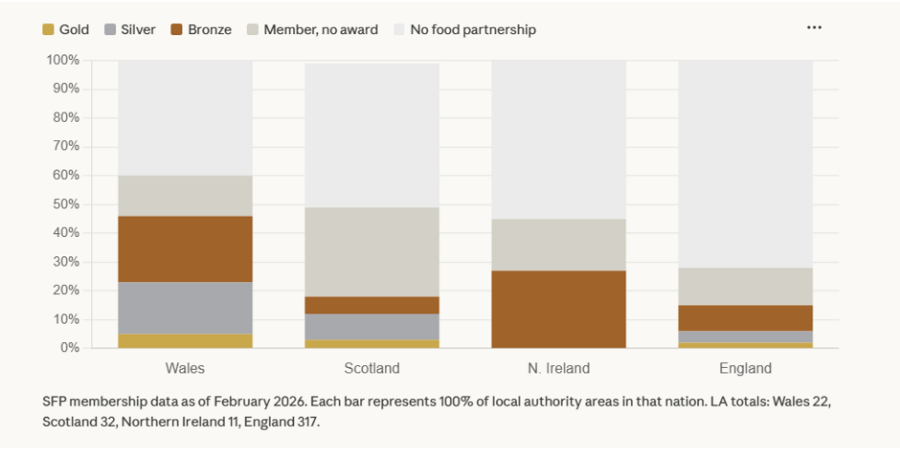
On this measure, the Wales picture is even more striking. Forty-five percent of Welsh local authority areas are covered by a partnership holding an SFP award. In England, that figure is 14%. Welsh partnerships are not just more numerous -they are, on average, operating at greater depth. Welsh Food Partnerships are reporting significant impact on their local food systems that is making healthy, sustainable food more accessible and local farmers more profitable.
Sustainable Food Places believes that is what sustained, strategic investment makes possible.
Scotland and Northern Ireland sit between the two -with award-holding rates of 19% and 27% respectively. Their trajectories will be worth watching closely as conversations about national funding for food partnerships develop. The Welsh data gives those campaigns a powerful evidence base.
How Local Food Partnerships can put food at the heart of the new Welsh Government
With a commitment to develop a National Food Strategy, the newly elected Plaid Cymru Government is promising to do more to ‘build food security and literacy, shorten and strengthen food supply chains, and use the public plate to support and develop the Welsh food and drink industry.’ The network of Local Food Partnerships in Wales could be a mechanism to help deliver these priorities. Indeed, one of the exciting things about food partnerships is the coordination and infrastructure they provide. By building these foundations, local food partnership action is agile and responsive to changing priorities, whether that be from what communities need, external shocks, political priority shifts.
What England, Scotland and Northern Ireland need to hear
The question was never really whether statutory funding works. Wales has answered that. The question now is whether England -and the devolved governments of Scotland and Northern Ireland - will act on the evidence in front of them.
Food partnerships are connective tissue: the infrastructure that holds together local responses to some of the most complex challenges communities face. When that infrastructure is allowed to fray -through short funding cycles, year-to-year uncertainty, and the slow attrition of talented people who cannot plan beyond the next grant round -the losses are real, and felt locally (delivery and purposeful coordination) and nationally (engaged leadership and peer learning).
SFP has heard clearly from our members that
“Where financial support is available - whether through local authority investment, external grants, or pooled resources - partnerships are able to sustain coordination, expand delivery, and innovate. Lack of long-term funding, however, remains the most widely cited barrier to progress[2]”
Wales chose a different path. The rest of the UK is watching -and some of its food partnerships are running out of time to wait.
Read the 2026 Local Food Partnership Status Report here
You can also read more about Wales’ network of Local Food Partnerships here; read some case studies here, watch a playlist of case study films here or watch the explainer video below.
[2] Local Delivery, National Impact Insights from the 2025 Sustainable Food Places Survey: SFP: April 2025
Sustainable Food Places
c/o Soil Association
Spear House
51 Victoria Street
Bristol
BS1 6AD
info@sustainablefoodplaces.org
Through the power of partnerships we make healthy and sustainable food a defining characteristic of where people live.
2026 © Sustainable Food Places
Data privacy & cookies
Sustainable Food Places is powered by: