
Greater Manchester is providing some valuable early learning. We've collaborated with them on this summary of their approach, which will be complemented by the launch of our new toolkit, Making Devolution Work for Food, and supporting webinar for SFP members in September.
The GM Approach: Community: Local: Regional scales
Across its ten boroughs, local food partnerships are at different stages of development. Alongside them, the Greater Manchester Food Partnership Board, supported by GMCA, provides strategic leadership for food across the city-region, bringing together partners to help create a fairer, healthier and more sustainable food system.
Together, this is beginning to form nested food partnership infrastructure: communities and neighbourhoods connected to borough-led food partnerships, which are themselves connected across Greater Manchester and into the institutions and policy levers of the city-region. This work has benefitted from strong political support across the Boroughs, and Greater Manchester Combined Authority. As Cllr Tom Ross, Leader of Trafford Council and Chair of the Greater Manchester Food Partnership Board says:
“Food touches every aspect of our lives, from health and wellbeing to community cohesion, sustainability and economic growth. Our ambition is to make Greater Manchester a place where good food is a right, not a privilege. The strength of our approach lies in connecting the incredible work already happening in each of our ten boroughs with a shared city-region vision, ensuring we learn from one another, scale what works and deliver greater impact together. By aligning local delivery with Greater Manchester-wide action, we can build a food system that is healthier, fairer and more sustainable for current and future generations”
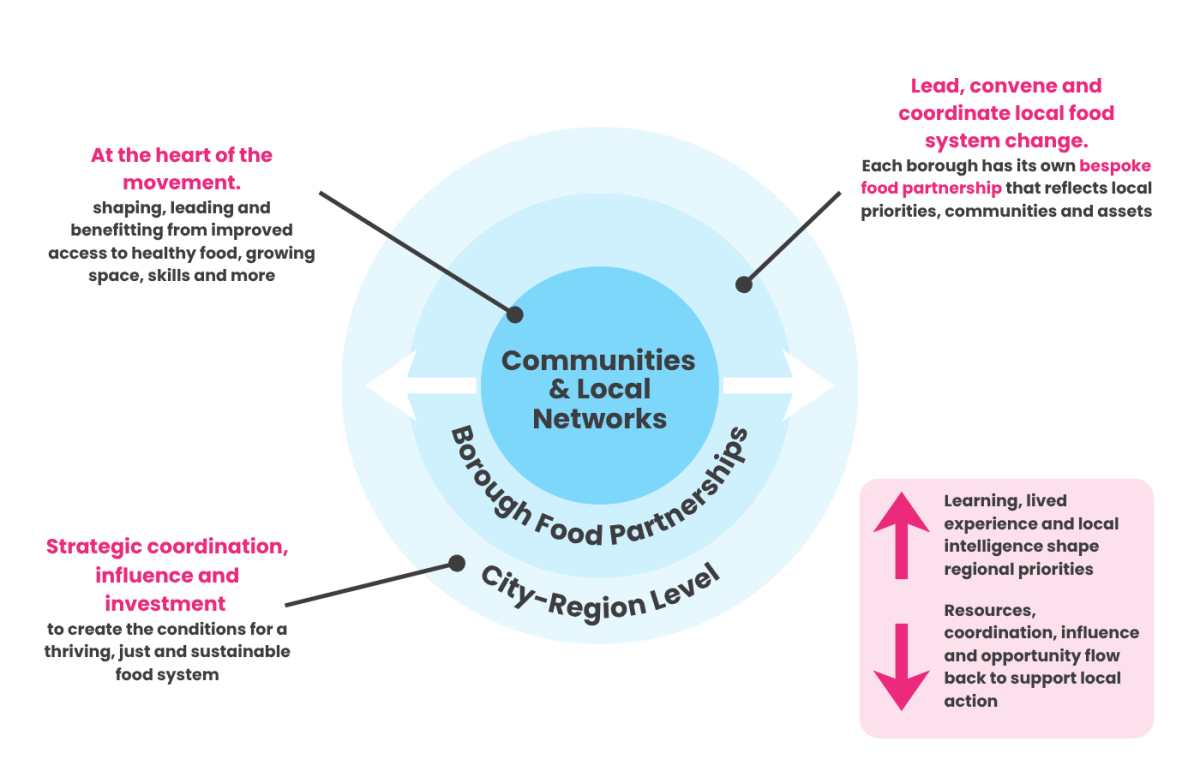
SFP Image: illustrates the nested relationship between communities, local food partnerships and strategic authorities.
Strong regional working needs strong local roots
Local food partnerships provide the roots for this approach. They create accessible routes for communities to participate in shaping their food system, bringing living experience together with local government, health, businesses and civil society. This strengthens representation and helps food strategies respond to the particular cultures, economies assets and inequalities of a place.
Those relationships also create legitimacy for work at larger scales. Regional priorities can be informed by everyday experience of food access, food environments and community capacities. Greater Manchester is now focussed on strengthening the connections between these local systems. A recent Sustainable Food Places 'MOT' across all ten boroughs identified common strengths and challenges and provided an evidence base for GM-wide priorities.
Three opportunities emerged particularly strongly from these MOTs:
strengthening capacity and funding;
improving impact and evaluation capacity; and
accelerating whole-system work around areas such as procurement, supply chains and sustainability.
The question becomes: where can acting together achieve something that individual boroughs cannot achieve alone?
Creating a route for local innovation to travel
Bury offers a tangible example of what this connected infrastructure can enable. From the outset Bury Food Partnership has adopted whole systems thinking, and prides itself on being a creative space, to connect, challenge and shape the way Bury sources and provides good food for all.
A specific intervention Bury Food Partnership has focussed on to enhance access is the role of traditional markets in creating dynamic and inclusive local food economies. Markets can respond dynamically to the cultural and demographic character of their communities, create accessible routes into food enterprise and employment, and build skills and local supply chains. Not to mention their role as deeply relational places that create everyday opportunities for strengthening social bonds and community connectedness.
Policy can reinforce these benefits. Bury Council has supported market traders to accept Healthy Start vouchers and marketed this widely across the borough, connecting improved access to healthy food with support for local traders and helping more money circulate within the local economy.
Learning from Bury has now fed into the Greater Manchester Strategic Markets Partnership. This creates a route for the other nine boroughs to learn from and adapt the approach, while GMCA can bring city-region levers including transport and infrastructure, strategic convening, evidence and investment.
This illustrates an important function of regional food partnership infrastructure: innovation can start locally, travel between places and gain greater influence through action at a larger scale.
“Bury Food Partnership is deliberate about reframing the food system narrative by asking what can we do so that everyone has a choice. We want to show that food can be the solution, it’s about the True Value of Food.
Bury Market (founding members of the Bury Food Partnership), places local healthy food at the heart of our town’s identity. The Market plays an important community role being well-used by low-income families and older demographics and drawing in newer audiences by hosting cultural events and Youth Markets. Bury Market fully embraced promoting Healthy Start and the Market’s role in the national Healthy Start voucher scheme has become a model for community wealth building, connecting local families with local traders.”
Francesca Vale, Bury Food Partnership Coordinator
What might this mean for evolving devolution in England?
Greater Manchester is one of several places helping SFP think about this question.
Through our wider work on devolution and with emerging regional food partnership cohorts across England, we are exploring how local food partnerships can collaborate across larger geographies and build effective relationships with combined and strategic authorities.
Different places will develop different structures. What is beginning to emerge is the importance of two-way relationships between scales. Community experience, local evidence and innovation can inform regional priorities. Regional institutions can bring policy levers, investment, infrastructure and convening power back into places. Boroughs can share learning and collaborate with one another. Strategic mapping of assets and gaps across boroughs can strengthen the whole (eg mapping demand to inform growing and routes to market). Strong regional working can, in turn, increase the capacity and influence of local food partnerships.
As Chloe Smee, Sustainable Food Places Programme Lead comments:
“It’s been incredibly insightful learning alongside Greater Manchester and other regions to understand what effective food partnership infrastructure looks like across different scales - and importantly how devolution can strengthen place-based food-system change rather than distance decision-making from the people and communities it affects.”
Greater Manchester's approach is still developing, and that makes the learning accessible and relatable. SFP certainly don’t underestimate the challenges of resourcing partnership working, which requires considered and iterative governance and intentional collaboration.
The opportunity devolution offers, as demonstrated by Greater Manchester, is to build food partnership infrastructure that is rooted in communities, connected across places and strengthened through city-region collaboration. In Greater Manchester, this approach is closely aligned with the ambitions of Live Well, recognising that access to healthy, affordable and sustainable food is fundamental to supporting good lives, reducing inequalities and helping communities thrive. By connecting local action with strategic leadership, food partnerships can play a vital role in creating a fairer and more resilient food system for everyone
Sustainable Food Places
c/o Soil Association
Spear House
51 Victoria Street
Bristol
BS1 6AD
info@sustainablefoodplaces.org
Through the power of partnerships we make healthy and sustainable food a defining characteristic of where people live.
2026 © Sustainable Food Places
Data privacy & cookies
Sustainable Food Places is powered by: